May 19, 2022
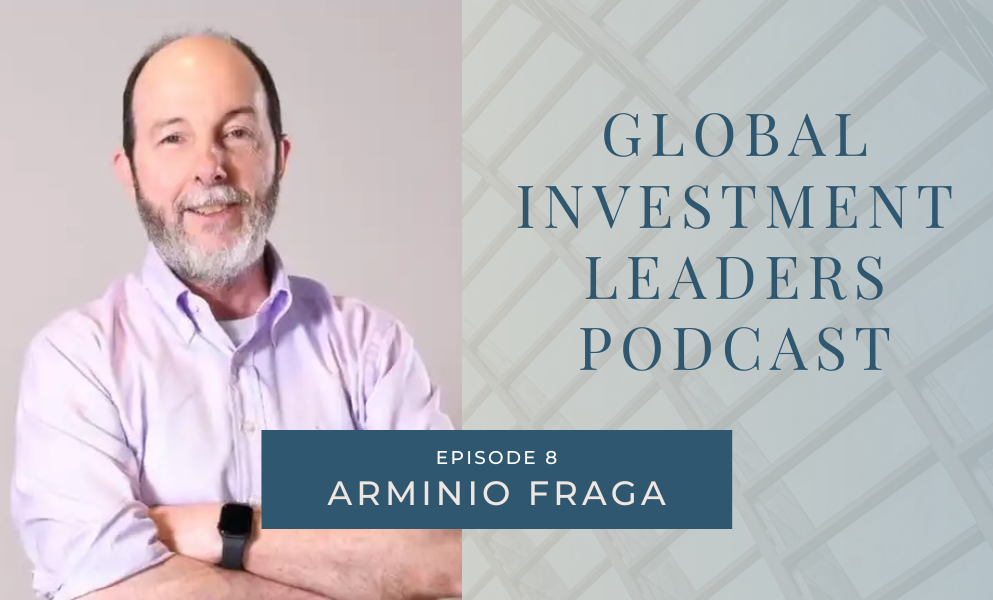
In this special edition episode of the Global Investment Leaders podcast, Gávea Investimentos Founder Arminio Fraga brings his unique background in academia, public policy and investment management for a discussion about the global economy and the opportunities and challenges that exist for investors. During the episode, Fraga shares insights from his extensive background before founding Gávea, which includes roles as President of the Central Bank of Brazil, Managing Director of Soros Fund Management and positions with Salomon Brothers and Garantia Investment Bank. Fraga has also taught as an adjunct professor at the School of International Affairs at Columbia University and the Wharton School, among others.
From the perspective of Gávea, a leading independent alternative asset management firm focused on emerging markets, Fraga shares his thoughts on the geopolitical environment challenging investors across the globe. While Fraga jokes that economists are paid to worry, the concerns topping his list include 40 years of low declining interest rates that have risen materially, very high inflation in the US and Europe and massive supply-side problems in Russia, Ukraine and China. Further, Fraga notes that the increasing rise in authoritarian leadership globally underscores the importance of understanding that when investing in emerging markets, the norms and regulations under which we operate in the western world only apply to approximately one-third of the globe.
However, Fraga finds that many reasons remain to be optimistic. For example, in emerging markets like Brazil, in which Gávea specializes, people every day are taking the opportunity to learn, improve and build companies that serve a need, which in turn creates investment opportunities. For Gávea, this means identifying businesses led by outstanding leaders who are looking for support in the areas of strategy, finance, risk, people and value creation. One example is ReGreen, a company that aims to restore 1 million hectares of Atlantic Forest and Amazon rainforest in Brazil, in which Gávea invested. “Our goals are substantial, but I don’t think I’ve ever been as excited about an investment,” Fraga shares, noting the tailwinds of regulation and a world increasingly focused on ESG.
All episodes of the Global Investment Leaders podcast are available on Apple Podcasts, Spotify, Google Podcasts and more. Receive the episodes as soon as they premiere by subscribing today.

May 12, 2022
Merger and acquisition activity in the investment management industry has sustained a torrid pace over the last few years. Buyers and sellers are ubiquitous, but rationale and “fit” are diverse and far ranging. Bruce Cameron, co-founder of Berkshire Global Advisors – the first independent investment bank specializing in the investment management and securities industries – joined Rosemont CEO Chas Burkhart on the Global Investment Leaders podcast. During this episode, Cameron shares his insights on a wide range of topics on the M&A environment and Berkshire’s evolution and brand.
During their conversation, Cameron and Burkhart discuss:
- The driving forces behind the M&A euphoria that accelerated during the pandemic and has resulted in a record number of deals, including the inflow of capital, soaring valuations and buyer and seller perspectives
- The particular terms, criteria or structures used by firms that are winning certain transactions and considerations beyond price
- How investing through downturns has curbed the appetite for too much leverage and too robust projections among more experienced investors
- Investment banking compensation and transaction outcomes: a view on what constitutes “success” and how bankers are paid
- The importance of building and maintaining long-term relationships with clients and how Berkshire seeks to evaluate its clients’ needs and advise them long before a transaction is likely to be consummated
Toward the end of their conversation, which was recorded in December 2021 before geopolitical conflict and record-breaking inflation dominated our headlines, Cameron and Burkhart discuss the precarious environment of the marketplace and how a correction may impact the M&A environment in the months and years ahead.
All episodes of the Global Investment Leaders podcast are available on Apple Podcasts, Spotify, Google Podcasts and more. Receive the episodes as soon as they premiere by subscribing today.

April 28, 2022
For some publicly traded investment firms, tension can exist among stakeholders given the potentially competing interests of shareholders, employees and clients. In the latest episode of the Global Investment Leaders podcast, Diamond Hill CEO Heather Brilliant, CFA, joins Rosemont CEO Chas Burkhart to discuss how her firm seeks to align these interests. According to Brilliant, putting clients’ interests first is the key to Diamond Hill’s long-term success for its shareholders, with its employees investing right alongside clients.
“We do think of ourselves as an aligned boutique, aligned with our clients but also through a set of principles about investing that we believe to be true,” says Brilliant. These principles include actively managed, concentrated portfolios, a long-term perspective, a capacity mindset, and valuation discipline. According to Brilliant, these fundamental principles carry through to everything they do at Diamond Hill, and the firm seeks to ensure every investment team is committed to upholding those principles.
During their conversation, Brilliant and Burkhart also explore how differing perspectives can enhance a team’s effectiveness and culture. Specifically, they discuss:
- Brilliant’s background and her insights on the global investment community following her leadership roles at Australia’s First State Investments and her role as CEO at Morningstar Australasia
- The differences between the investment industry culture in Australia and the U.S., particularly around collaboration and sharing of best practices
- The opportunities and challenges that come with being a female CEO in a traditionally male-dominated industry
- How she believes cognitively diverse teams are better equipped to solve problems and how the industry would benefit from attracting more women and people of color
- How the next generation will continue to define the industry through a lens of purpose
All episodes of the Global Investment Leaders podcast are available on Apple Podcasts, Spotify, Google Podcasts and more. Receive the episodes as soon as they premiere by subscribing today.

April 13, 2022
Among the large philosophical questions facing our industry, the view of investment management as a business versus the view of investment management as a profession, much like law or medicine, is paramount. This viewpoint determines how strategic decisions are made, from growth and M&A to allocation of capital. And at the core, it determines how firms act as stewards of the capital they manage.
John Taft, Vice Chairman of Baird, joined Rosemont CEO Chas Burkhart on the newest episode of the Global Investment Leaders podcast to discuss how he views stewardship of capital and some industry trends that have the potential to serve as headwinds or tailwinds to society’s greater good and clients’ benefit.
Chief among these trends is the flurry of M&A activity over the last several years. On one hand, thoughtful acquisitions and inorganic growth have the potential to benefit clients, as is often the case when a team joins a larger organization that has broader access to investments, better systems, or a superior service model. On the other hand, a returns-driven approach to M&A is often the objective, which can result in short-term profitability taking precedence over long-term benefits for clients.
“The primary focus needs to be on what’s best for the client. Every time we’ve gotten away from that and focused on what’s good for management or shareholders, we have strayed from the core principle of stewardship and have gotten ourselves and society in trouble,” says Taft.
Another emerging trend that Taft believes is here to stay is the alignment of values with investment strategies. While Taft cites the lack of standardized measurement as a hurdle, he believes the increasing interest in impact and ESG factors will lead to greater good for both investors and society in general.

April 8, 2022
For established, growing investment firms seeking capital for objectives such as reinvestment, acquisitions or shareholder liquidity, there is far more capital available today than ever before. Financial institutions, aggregators, consolidators, angel investors, multi-boutique affiliate models, private equity, debt, and permanent capital options abound.
As the landscape of options has become so broad and often overwhelming, the optimal capital choice requires clarity and priority of objectives. For those for whom shareholder liquidity is the priority, initial valuation is far and away the most important factor. This is certainly understandable, as several industry segments (notably wealth management and alternative asset management) consistently command very high valuations for this purpose.
For others, finding the most helpful partner is the highest priority. Naturally, what is “most helpful” varies greatly. Often distribution or asset-raising assistance is a key driver. Are there sub-advised funds to be managed? Is there a centralized sales and marketing team to leverage? And what about the ability to help source acquisition and bolt-on candidates? That might extend to helping the seller enter new markets or geographies. Aside from growth, “helpful” can include bringing more functional resources to the table: technology, compliance, operations, HR, or balance sheet and “war chest” resources. Is the search for “helpful” more important than or equal to the quest for liquidity, if both considerations are at stake?
A third consideration is “fit.” This would include governance, the relationship (will it be enjoyable? irritating? exasperating?), and alignment of interests. There are many nuances to “fit.” Is maintaining majority employee ownership (or any material employee ownership) important, or would joining a parented superstructure make the most sense? Is an indefinite solution with no time frame or liquidity needs important, or is a short-medium term horizon with attached goals the preferred route? Are any financial structures strongly preferable—such as preferred arrangements, revenue share, bottom-line distributions, common equity/pro-rata, etc.? Will profits be distributed or reinvested?
Apart from bank debt, mezzanine or other pure financing options, the wide array of capital partners/investors and acquirers are evaluated on all these criteria. The balance (or imbalance) of valuation, “helpfulness” and “fit” are weighed; there are no automatic or assumed correlations between the three.
With these criteria in mind, how does permanent capital differentiate itself from all the other solutions? Three elements define the essence of permanent capital: duration, strategy and valuation.
Before we discuss the three elements, it should be acknowledged that the term permanent capital is fluid; it can be used in connection with any publicly traded investment company, long-dated PE funds with horizons over ten years, and on rare occasions, private investment companies with no defined investment horizon or specific capitalization goal, i.e., truly permanent.
Duration should be a critical factor to alignment; the permanent capital partner should never need to look for the exits at what may be an inopportune time or against the wishes of management. Further reinvestment in the business is not viewed through the lens of whether a holding is early or late in its life cycle, as a PE fund or time sensitive holding must. This will color if and how such reinvestment might be made (technology, acquisitions, significant hires, etc.).
On the subject of strategy, running a business with an infinite timeframe versus running one with a 5–10-year timeframe dictates strategy, period. Instead of considering acquisitions, growth plans, and significant shifts in how you run the business opportunistically and with only the long-term best interests of the company in mind, non-permanent solutions have fuses that have been lit and all such decisions need to be weighed against the length of the fuse.
On distribution in particular—adding marketing resources or joining a centralized sales and marketing platform—ideally, they would not be short-term decisions requiring quick payback (less than three years). An acquisition might be accretive day one, but marketing reinvestment/repositioning might take three to five years to be fully evaluable.
With regard to valuation, permanent capital has the benefit of being able to provide ongoing liquidity, growth capital, and other valuation support indefinitely. Therefore, prioritization of the seller is critical. How important are up-front dollars versus dollars over time for these myriad reasons? Permanent capital tends to look at valuation and value creation over a much longer timeframe and multiple cycles as opposed to immediate paydays and five-year value creation. Publicly traded permanent capital companies may produce greater valuation arbitrage for the seller (sellers’ value vs. the value of the entire entity), but that has proved to be inconsistent and highly variable. Some have, some have not.
Back to where we started: the seller’s objective. There are a dizzying array of options and checkbooks. While permanent capital is not inherently better than any other capital source, beauty is always in the eye of the beholder. For those who prioritize no artificial timeframes to impact decision making and the potential to create substantially more value over time, permanent capital stands apart from the crowd.

Recent Comments